Mid Summer Ski Descent of Mallory on North Face of Aiguille du Midi with Leo Slemett

One of my biggest dreams was to ski the mythical Couturier Couloir off the mighty 4122 m Aiguille Verte…in powder. From one of the wildest summits in the Mont Blanc Massif a 1000 m of sustained 50/55 degrees. I went up to the refuge prepared for a solo adventure. I knew Gabriel Rivas was heading up with some other friends though he was wanting to ski Col de la Verte. In the end Gabriel teamed up with me and yesterday that dream became reality. Twenty years in the waiting, lots of sacrifices to obtain this one including many jobs, and it lived up to all expectations. What a mind blowing adventure. Great snow, amazing company, intimidating situations with the smattering of snow and the ever present death ice out right acting as a constant reminder to go canny. The line went clean using the lower traverse into the Washburn variation. SUPER STOKED.
After we chatted on the rognan col for a long time and said our goodbyes, I wanted to drink beer and Gabriel was gonna straight line across to the Argie hut to stay another day.
Down on the flat glacier below, a moments lapse of concentration and Gabriel hit a block of ice at speed and tomahawked hard into other blocks of ice. Would you believe it – we’ve just skied the Couturier??! When I got to him I could see the impact on his helmet had probably broken his nose. Struggling to breath and with lots of internal pain, it was an easy decision for me to call a rescue chopper. 3 years ago I javelined head first into the ground out riding and the damage to my back almost prevented me breathing so I could imagine where he was at – its pretty scary when your ribs cage locks out, completely different to being winded which is bad enough, more like drowning – when I flew to the Netherlands the next day for work I had to get Alan White to carry my bags!
Fortunately the rescue was quick, unfortunately Gabriel suffered 3 broken vertabrae, 2 broken ribs and contusion to a lung. Get well soon Gabriel and thanks for an all time day. I drank your share of the beer last night too!
One of my biggest dreams was to ski the mythical Couturier Couloir off the mighty 4122 m Aiguille Verte…in powder. From one of the wildest summits in the Mont Blanc Massif a 1000 m of sustained 50/55 degrees. I went up to the refuge prepared for a solo adventure. I knew Gabriel Rivas was heading up with some other friends though he was wanting to ski Col de la Verte. In the end Gabriel teamed up with me and yesterday that dream became reality. Twenty years in the waiting, lots of sacrifices to obtain this one including many jobs, and it lived up to all expectations. What a mind blowing adventure. Great snow, amazing company, intimidating situations with the smattering of snow and the ever present death ice out right acting as a constant reminder to go canny. The line went clean using the lower traverse into the Washburn variation. SUPER STOKED.
After we chatted on the rognan col for a long time and said our goodbyes, I wanted to drink beer and Gabriel was gonna straight line across to the Argie hut to stay another day.
Down on the flat glacier below, a moments lapse of concentration and Gabriel hit a block of ice at speed and tomahawked hard into other blocks of ice. Would you believe it – we’ve just skied the Couturier??! When I got to him I could see the impact on his helmet had probably broken his nose. Struggling to breath and with lots of internal pain, it was an easy decision for me to call a rescue chopper. 3 years ago I javelined head first into the ground out riding and the damage to my back almost prevented me breathing so I could imagine where he was at – its pretty scary when your ribs cage locks out, completely different to being winded which is bad enough, more like drowning – when I flew to the Netherlands the next day for work I had to get Alan White to carry my bags!
Fortunately the rescue was quick, unfortunately Gabriel suffered 3 broken vertabrae, 2 broken ribs and contusion to a lung. Get well soon Gabriel and thanks for an all time day. I drank your share of the beer last night too!

Ross Hewitt skiing the North Face of Aiguille du Plan – 60 m RAD line body coiled.
In 2016 Petzl recently released the RAD (Rescue And Descent) line rope which is a lightweight rope that can be used with other components of their RAD system for glacier travel, crevasse rescue and abseiling down cliffs. While I’d used skinny 5.5 mm spectra or dyneema abseil ropes for many years before that, they had severe limitations as the sheath wasn’t bonded to the core, making them a dubious proposition at best for crevasse rescue scenarios.
The RAD line is a 6mm static rope that is made from high modulus polyethylene (Dyneema), aramid (a heat resistant synthetic fibre) and polypropylene. The sheath is bonded to the core so it can be clamped and climbed.
RAD Line Specification
Out of the box it is instantly apparent that the RAD lines are supplied without a middle mark, something I quickly rectified with a Petzl rope maker. I use a Reverso combined with a Prussic for abseiling. The reduced friction of the small diameter rope without a Prussic in the Reverso is notable. I try to avoid Italian hitches at all cost because they wear your ropes sheath and also induce twist in the rope.

Tof Henry rappelling with 60 m RAD line into the Couloir of Col du Plan
One trait the small diameter ropes have is their tendency to get in a tangle and putting them in a rope bag with save you a half hour of frustration every time. By tying the bag to the second end of the rope means the bag can be thrown to get the rope set on the line of an abseil efficiently in seconds, even if the wind is blowing up the line. My 60 m line didn’t come with a bag but I made one from an Exped inflatable mattress stuff sac. I can’t stress how essential these are and how often I see people in Chamonix with a bunch of knitting to sort out.

Getting ready for a big mission with the 30 m RAD line in its bag. Photo: Ross Hewitt
When rappelling or undertaking a rescue, a static line is great as there’s very little stretch to pull out the rope making it much more efficient. The flip side to this is the force of a fall is not reduced by the stretch which means that the system experiences a high force over a short duration in a fall scenario. Petzl testing indicates that there is a slightly better chance of arresting a crevasse fall with a static rope as the load is more predictable without a second pull, however falls on rock or during a rescue could be bad on a static rope.
The RAD line is a brilliant go to piece of kit that has served me well over the last years with its low weight meaning I often have a 60 m version in my pack. I’ve just bought a BEAL Escaper so it will be interesting to try that out and effectively half the rope required for certain abseils. Understanding it is static and the loading effect on anchors is important and its worth reading up Petzl’s tech tips here.
The complete RAD system comprises:

In 2016 Petzl launched its ultra light range of ski mountaineering and alpinism gear which comprise Gully axes with technical picks, 6 mm RAD line for glacier use, the Irvis Hybrid and Leopard crampons, and the Altitude harness.

Petzl’s Altitude harness was designed explicitly with light weight (150g) and pack size in mine. Its ‘wireframe’ construction is the key to its weight and low profile design. If there is any doubt if a harness is required there is no reason to leave it at home. It has an integrated belay loop making it easy to set up your cow’s tail and prussic for abseiling and anchoring to the belay. The leg loops have plastic closures so the harness can be donned with crampons or skis on and each loop has a silicone lined ice screw hold to stop you screws swinging around and while skiing and having the edge taken off the threads. A metal safety type buckle makes adjustment at the waist easy. Originally the harness had 4 vertically orientated thin tape loops for gear which I hated. Gear would bunch up and the tape loops would always catch in the gate. More than once I dropped a piece of gear because of difficulty in racking it. Thankfully Petzl have rectified this in the latest version with conventional gear loops.

I’ve used this harness since it launched in 2016 and durability is very good. It’s comfortable to wear all day ski mountaineering or lightweight easy alpinism but if I’m doing a route with hanging belays or a pitched climbing I will take a Sitta harness instead. One thing I noticed is the stiffness of the material might mean the leg loops catch when take strides but proper adjustment sorts this out.
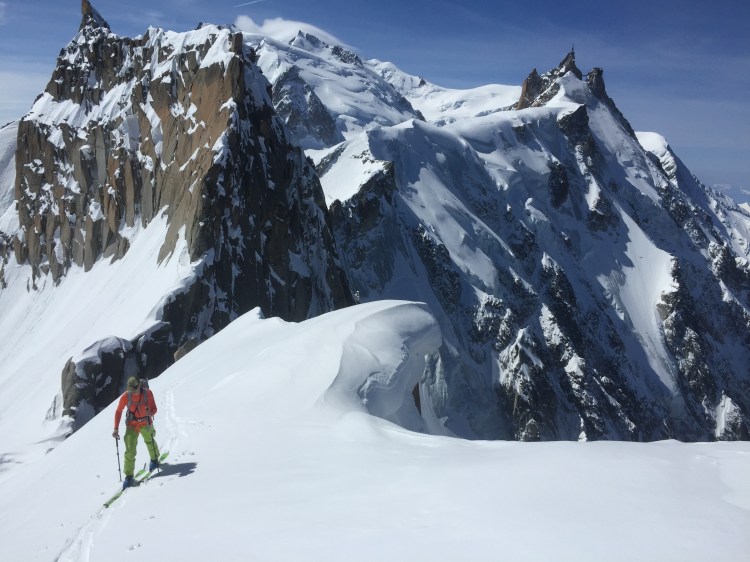
To summarise this is a great lightweight harness for suited to ski-mountaineering, light alpinism and expeditions. It also comes with a stuff sac to keep it compact in your pack and there are 3 size options.

 Ross Hewitt Guiding