***The Jones Route***
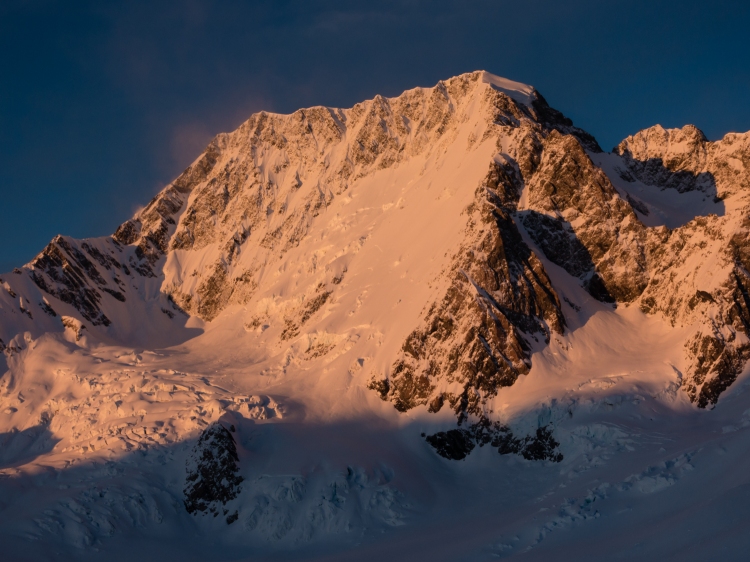
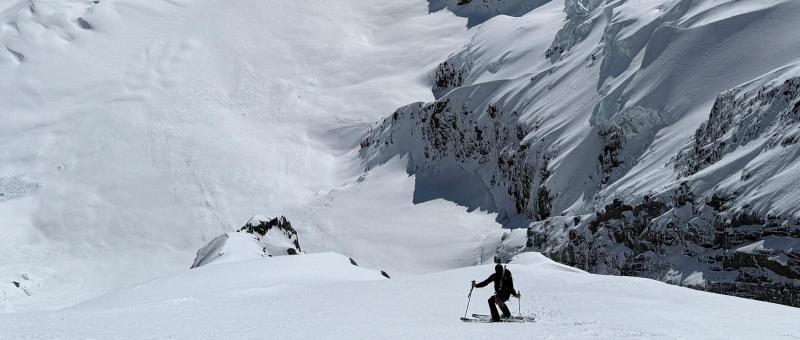
My alarm woke me from a deep slumber just after midnight, and I quietly eased out of bed, poking my head out the door. All was quiet, with no wind, but as I sat down to force some porridge into my stomach, that familiar howl of the Plateau hut announced the early arrival of the nor’wester. I still held some hope that Cook might provide enough shelter for us to succeed and if you don’t go you won’t know. As we headed out the door Mathurin bade us fairwell and dropped the bomb with a youthfall meaningwell chuckle – ‘it’s 1 year since Tof tragically lost his life in Chile, don’t die today’. Guillaume and myself briefly locked eyes before going out the door, both of us clearly feeling the superstitious omen that had been placed in the front of our minds about the loss of our dear friend. Trying to put that behind us, we skied out the into the dark but as we crossed the Linda and felt gusts ramming against us, I could sense the wind eroding my hopes.
We skinned up onto the bench, maintaining distance from the seracs on the east face, and quickly identified the start of our route. For the moment, we were sheltered, and I led us into the shrund. As I stepped onto a fragile jammed block of snow, I was shocked to see it span a massive hole plunging into the depths of the glacier. I quickly shouted for Gee to keep the rope snug between us. To navigate the overhanging lip, I had to cut a ledge for my knee and chop away the snow above so that my ski tips wouldn’t catch as I delicately levitated upward. We quickly moved onto the spine, where the snow was decent, but any shelter we felt was merely a momentary pause in the weather. Soon, violent downdrafts had us gripping our tools and hugging the slope until the worst had past.
By the time we reached the top of the spine, the wind had worsened. We climbed up the steep ramp, which rose 600 meters up the face, only to find that the surface had been baked by the heat of the day before. With a deteriorating forecast and poor conditions, it was an easy decision to bail and leave it for a reset. We all had plenty of time of left in New Zealand for another attempt. Later back at the hut Gee and myself admitted how Mathurin’s comment about Tof had eroded our resolve. As I write this month’s later, readily able to admit how scary the gusting wind was, trying to tear us off the mountain while we over gripped our axes, I can see maybe Tof was telling us that it wasn’t the day to push.
We rolled back into the hut to welcoming arms of our friends who had watched worrying as we had battled it out in the maelstrom. Soon after our heli arrived to transport us to hot showers, golden nectar, warm beds and the chance to process what for me, had been an insanely intense experience with the skiing on Silberhorn and Syme living up to my wildest imaginations of progressive big mountain freeriding.
On the other hand, there was a bitter pill to swallow as the twists of fate would prevented me skiing these plum lines on Aoraki Cook – an injury had forced me out of the first descent of the Caroline in 2017, in 2019 I didn’t have a partner, in 2024 the ice seracs on Caroline no longer look inviting breaking up the line, and now Jones would slip through my fingers.
***(The Dragon’s Back***
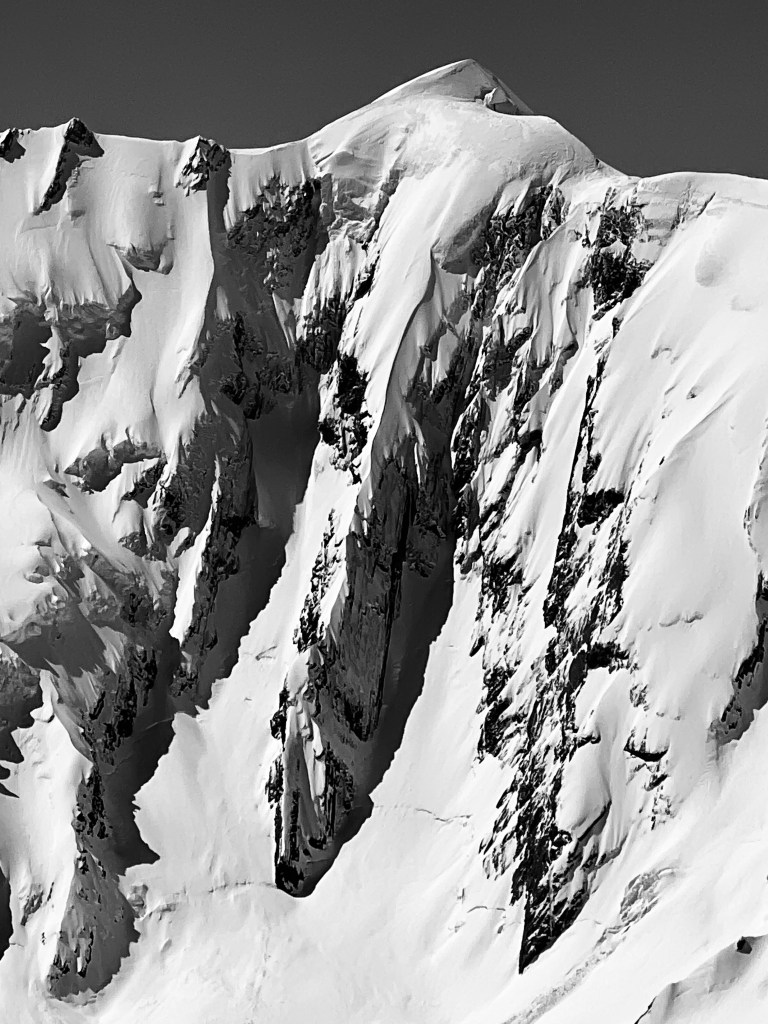
Eight years previously, I embarked on a first descent of Elie de Beaumont down its majestic right flank. As I glided effortlessly over the snow, I felt an irresistible pull to the central spur looming above me. It struck me as a magnificent sleeping dragon, its features strikingly defined in the rugged landscape. The contours of its snout and the gentle curvature of its eyes were eerily clear against the backdrop of the mountain. As I continued my descent, the dragon revealed more of its form to me. The head and back emerged from the swirling snow, and soon, the haunches and wings unfolded like a grand tapestry along the slopes. This breathtaking sight ignited my imagination, urging me to contemplate the exhilarating possibility of skiing along the spine of this mythical creature’s back, tracing its contours with each turn on my skis.

As the years slipped away, time felt as though it was accelerating, a fleeting reminder of my own ageing process. In 2017 and 2018, I was deeply immersed in the rigorous training and demanding examinations required to become a guide. Our trip to New Zealand in 2019 was marred by unrelenting poor weather, and then the onset of 2020 arrived, marking the beginning of the COVID-19 pandemic, which effectively sidelined me. Shortly after, we embarked on the journey of starting a family. Amidst these life changes, I often stumbled upon a cherished photograph from our 2016 descent, featured in a published article. It ignited a spark of inspiration within me for further research on the elusive central spur. Yet, much to my dismay, I discovered that most images of this formidable face were taken from a distance of 10 to 15 kilometres. This made deciphering the enigmatic nature of two indistinct crux features particularly challenging, as they lay obscured in areas of poor resolution, too pixelated to draw any clear conclusions. The west side of Elie is a wonderfully remote and rugged landscape, adding complexity to any reconnaissance efforts. Its wild beauty may be alluring, but navigating this challenging terrain is far from easy, making every exploration a true adventure.
As we returned to the present day, we embarked on a breathtaking eight-hour drive from Mt. Cook Village, navigating the winding roads of Haast Pass. The journey took us along the rugged, largely uninhabited West Coast, leading us to the charming township of Fox Glacier. The landscape evolved dramatically, beginning with sprawling golden grasslands and picturesque braided river valleys, interspersed with vast, shimmering lakes. Gradually, these vistas transitioned into dense, impenetrable jungle, where the air was thick with the scent of lush vegetation. We encountered isolated, sandy beaches that met the deep blue waters of the Tasman Sea, a striking contrast to the vibrant greenery around us. Exotic birds flitted through the trees, and the sight of tumbling glaciers added a touch of majesty to the scene. It felt almost surreal, as if we were in a land where Vietnam’s tropical beauty harmoniously intersected with the grandeur of the Himalayas, inviting us to enjoy ice cream by the sea while gazing up at a giant green pigeon perched high in a palm tree.


After a rough night at NZAC’s Porter Lodge in Fox, where the loud snoring of fellow occupants disrupted our sleep, we awoke to a breathtakingly cold and crisp morning along the coast. A thin layer of ice coated the windshield of our car, glinting in the early light. My aspirations of skiing down steep slopes 3,000 meters above were dampened, much like the biting temperatures that surrounded us. It would take a significant amount of warmth to melt the hard, crusty layer left from the previous week’s freeze-thaw cycle. The weather forecast promised the next two days would be cold yet clear with strong winds, while the third day was expected to be calm and pleasantly warm, perfect for our primary goal. West-facing slopes always pose a challenge, as they absorb the afternoon sun and require that same warmth to transform into enjoyable skiing conditions. With an understanding of the nuances of the terrain, we were eager to see how the conditions would evolve over the coming days.
After a quick and hearty breakfast of steaming oats and rich espresso, we set off for the airport, excitement bubbling within us. As the heli climbed it offering a breathtaking view over the stunning icefalls of Fox Glacier, shimmering in the morning light. Our eyes were glued to the window as the majestic Mt. Tasman came into view, its towering mass capturing our attention as we craned our necks to admire its splendor. Upon reaching the hut, we quickly claimed our bunks, stashing our gear in preparation for the adventures ahead. The bright sunshine and crisp mountain air invigorated us as we set out toward the Minarets, eager to seize the beautiful weather and reacquaint ourselves with skiing after a week away from the slopes. However, I have to admit, on that first day, I struggled. A string of restless nights spent in noisy and crowded mountaineering huts had left me feeling drained and dehydrated. During the climb, I paused and drank of half a litre of water, nearly gulping it down, and gradually started to feel more alive. Yet, fate had other plans for us. The snow gods conspired against our ambitions, as easterly winds sculpted tricky wind slabs on the headwall, ultimately forcing us to abandon our ascent. Disappointment washed over me to fail on such a moderate route. On the second day, I set my sights on skiing a small, steep spine, hoping it would help sharpen my focus for the challenges awaiting me. But the cold air had hardened the snow into an unforgiving surface, and once again, I found myself turning around before summiting. It was disheartening to squander two days of promising weather that could have allowed us to tackle much bigger objectives east of the divide. Even more frustrating was the realization that the challenging snow conditions were draining my confidence, leaving me uneasy about the task of conquering the Dragon’s Back on Elie the next day. As Day 3 dawned, it brought with it the promise of warmer temperatures, brilliant sunshine, and gentle breezes. With no alternative plans, we resolved to give it a shot.Our successful streak on Darwin, Dixon, Silberhorn, and Syme had reached its end with failures on Cook (Jone’s Route) and the Minarets, the question was what would fate have in store of us now?.

I meticulously packed six energy bars and two litres of water, preparing for a full 24-hour day of adventure. I desperately needed vital sleep in our cramped hut, which was filled with the restless sounds of snuffling and grunting like wild boars, making quality sleep and elusive commodity. After a leisurely start we set out from the hut at 7 a.m., the air crisp, the frosted world around us sparkling in the first rays of sun. We glided over the smooth icy surface of the 4 km glacial plateau until we reached the breakover point of the Styx Glacier. The next section from the Styx onto the Times Glaciers would be a crux in itself where precious time and energy could easily be lost, which could cost us our shot at the Dragon’s Back.

A steady descent of 350 meters lead into the chilly shade on grippy frozen snow, we found ourselves approaching an area overlooked by the towering an active Styx seracs, their ice formations glistening like colossal sculptures. My chest tightened with the thought of being underneath them and we veered leftwards to distance ourselves as much as possible. As we approached the glacier, the final stretch narrowed, and the slope steepened dramatically to a challenging 50 degrees. The snow beneath our skis became bullet hard, forcing us to transition carefully and downclimb, each movement requiring focus and precision. Suddenly, the sun breached the horizon, flooding the landscape with golden light and quickly raising the temperature by what felt like 30 degrees. In that moment, it wasn’t possible to stop and delayer; the heat enveloped us, the sweat poured off us, depleting our water precious reserves for the day. It was hard not to feel devastated by this loss but there was nothing we could do about it except get on with it. With determination, we pushed on until we finally reached the shade on the glacier, where we could finally peel off our heavy layers and revel in the brisk, refreshing air.

After strapping back on our skis, we briskly traversed beneath the towering seracs of the Styx Glacier, the looming ice formations casting an unsettling shadow over us. As we manoeuvred through the scattered boulders left by a recent buttress collapse, a wave of relief washed over me when we finally emerged from the overhead threat, feeling the warmth of the sun on my face. On the lower Times Glacier, we quickly stashed some water and snacks, ensuring we had supplies for our return journey, before embarking on the daunting 1,400-meter ascent to Elie de Beaumont. Beginning our ascent to the Elie-Walter Col, we past under the the rugged headwall of Mt. Walter which slowly started shedding its storm coating of rime in the strong sun. Chunks of water ice began to break free, accelerating towards us like homing missiles. We remained vigilant, scanning the rocky outcrops above for any signs of danger. After successfully dodged several larger pieces, but suddenly, a rounded chunk veered towards me in a menacing arc. It struck my toe piece with a jarring impact, knocking my ski loose. In a split second, I dove to the side, my instincts kicking in to retrieve the runaway ski and avoid losing it entirely.
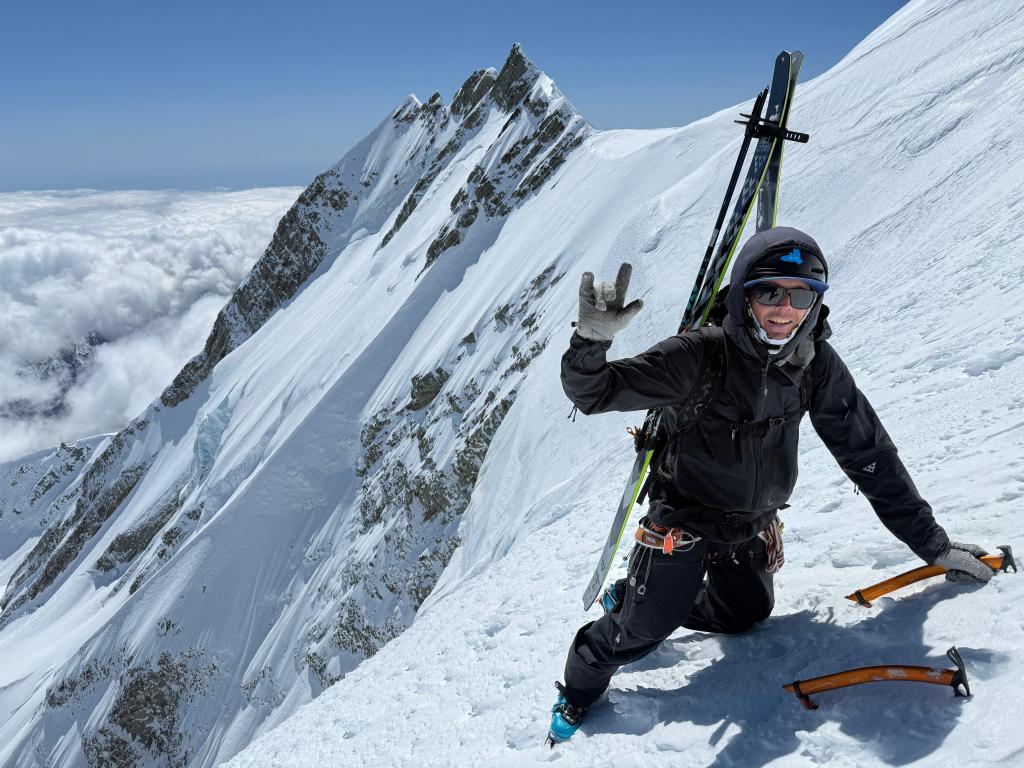
We arrived at the windless Elie-Walter Col after six hours of effort. While we ate a snack, we took the time dry our feet in the warm sunlight in an attempt to stop the skin going soft and peeling off. Finally, it was time to climb the ridge of Elie, where we were rewarded with a view of the Dragon’s Back, beautifully illuminated by the afternoon light and covered in a fresh layer of snow. Below the summit, the terrain was riddled with treacherous rime, and we carefully downclimbed to the skiable snow. At times, our boots plunged deep through the icy crust into soft snow beneath, almost causing us to lose balance and topple off the mountain backwards. It was more than a relief to reach a consolidated snowpack.
Now, we found ourselves atop the Dragon’s Back, hoping to make amends. I gazed across a sea of clouds flooding the valley below us from the west. This sight gnawed at my mind, as it would seriously hinder our return passage through the complex terrain of the Styx glacier. I recalled standing at the same spot eight years ago, preparing to ski while clouds piled up against the bottom of Elie’s west face. Back then, after skiing along the right flank, we turned around and climbed back over the divide, escaping the cloud and returning to Tasman Saddle. This time, however, we would return to Centennial Hut. These were problems for later, so I pushed them aside, letting the music on my phone bring me back to the moment. I sought the calm and relaxed mental state necessary for optimal performance, all while managing the tension from our precarious position above the void and the usual pre-match nerves vying for my attention.
A glance at my watch revealed it was 4:45 PM. I had been waiting for 20 minutes after making some initial turns. My first turn had been good, with my skis punching through the crust to the unconsolidated winter snow beneath. On the second turn, my edges glanced off the crust, struggling to grip the icy surface. I shouted to Beau, “We need to wait until 5 PM for this to soften more,” and stomped out another platform to make myself more comfortable.
I looked down at the glacier and watched as the evening shadows reached upward toward us. Soon, the snow would refreeze, becoming crusty and difficult to ski. My mind raced, trying to estimate how long we had before the shadows crept up the face, which would complicate our descent. My impatience grew as the realisation set in that perfect snow to the bottom was unattainable. I felt the snow’s surface with my fingers; the icy crust was beginning to soften. It was game time.
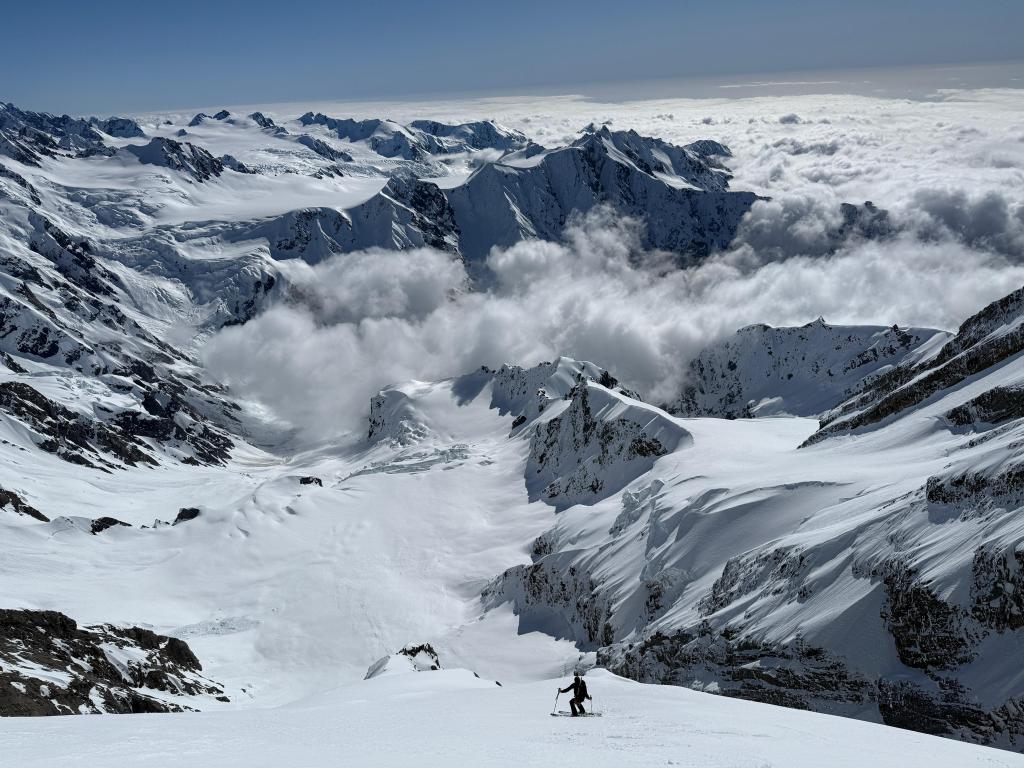
We skied quickly down the upper 45-degree shoulder onto the spine and onto the beginning of the difficulties. Beau joined me and skied through, revelling with the situation, surrounded by the tumbling blue seracs on our right and the gravitational pull of the void below. I knew he had been dreaming about this route for years; in fact, his laptop screensaver was a photo of Elie’s west face.

The crest of the spine had hard snow that forced us onto the steeper right side. Fortunately, this had softened nicely in the sun. With heady exposure on all sides, we both felt tense and apprehensive about what lay below—how steep it would get and the uncertainty of the rock sections. Would we find any rock anchors, or would we have to improvise or even downclimb?
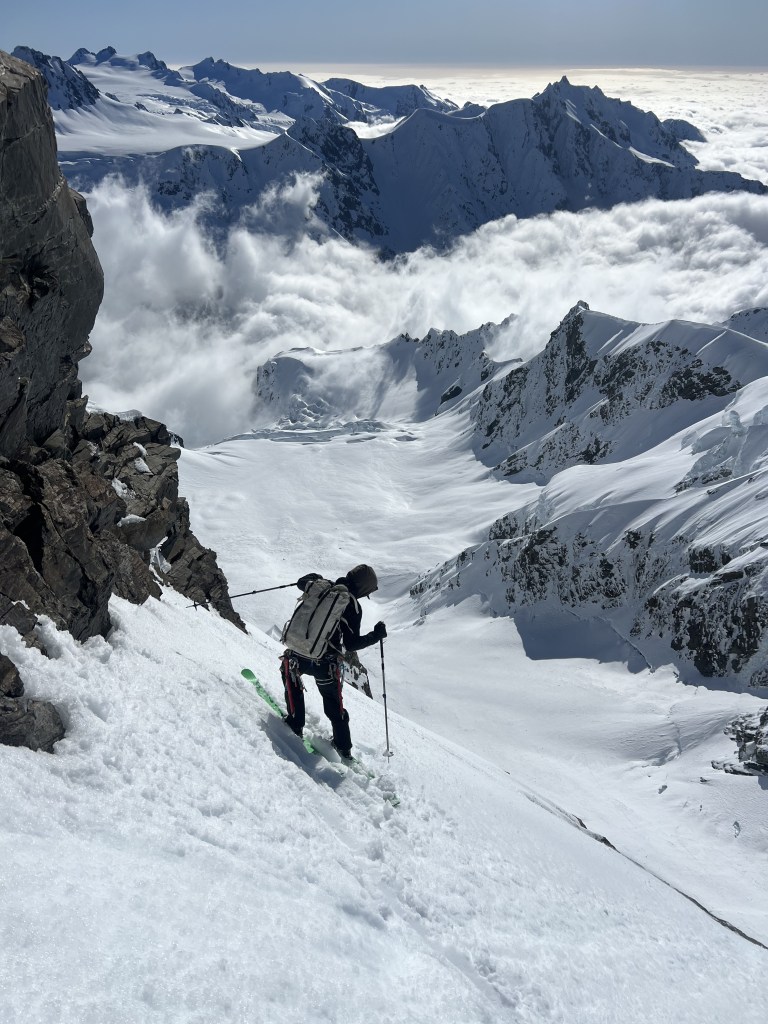
I took the lead, probing the snow ahead to test its edgability, making chop turns to avoid gaining speed and give my edges a chance to grip. I focused deeply, fully in the moment, losing all sense of time as we made magical, heady turns down the neck of the dragon.

The first crux was a rocky fault running diagonally across the face, with 2-3 meters of ice 30 centimetres wide linking to the lower 55-degree snowfield. Any thoughts of straight-lining were quickly replaced by the need to find an anchor. Beau tested a spike but soon realised it was the Jenga block, holding everything above. I created a bollard in the arête and backed it up by counterbalancing on the other side. This allowed Beau to downclimb securely, testing the quality of the ice for me to follow. I was relieved to find solid placements in the chewy well bonded ice.
Once back on skis, the next turns were perhaps the steepest of the route, especially given the off-camber nature of the spine. The snow was getting warm, making us nervous about triggering a wet pocket over the unconsolidated winter snow, but everything went smoothly, including navigating a second small rock choke. It was a wild, exposed place to ride.
A ramp on the right provided a straightforward exit to the glaciated bay and with the sun going down, we skied non-stop down the Times Glacier into thick fog. I snowploughed in front, keeping alert for crevasses while Beau followed behind using the GPS to locate our stashed food and water. We were 13 hours in at this point and still had 4 hours of uphill to go. I drank half of my water, exercising restraint to avoid gulping it all down. Despite my thirst, I couldn’t eat my sandwich and made do with the cheese and sausage filling while contemplating the tricky task of navigating the return journey in the fog under the Styx seracs.
Suddenly, the cloud parted along our route. “Now’s our chance, let’s go,” I said. Beau packed up frantically, and we skied over the snow and rock avalanche debris, skinning at a furious pace past the threat of the Styx seracs, sweating precious fluids we couldn’t afford to lose. Just as night fell, we returned to the safe ground of our approach, able to relax as the objective danger faded. Ahead remained a few hours of tough uphill wading up a combination of deep mush and occasionally teetering on the eggshell crust before cruelly punching through just as you committed it. Energy-sapping and soul-destroying. We inched forward, taking turns, hoping to gain some rhythm, looking forward to it being over. These next hours would be without food or water and we were sweating a lot as we battled to make progress with the poor snow.
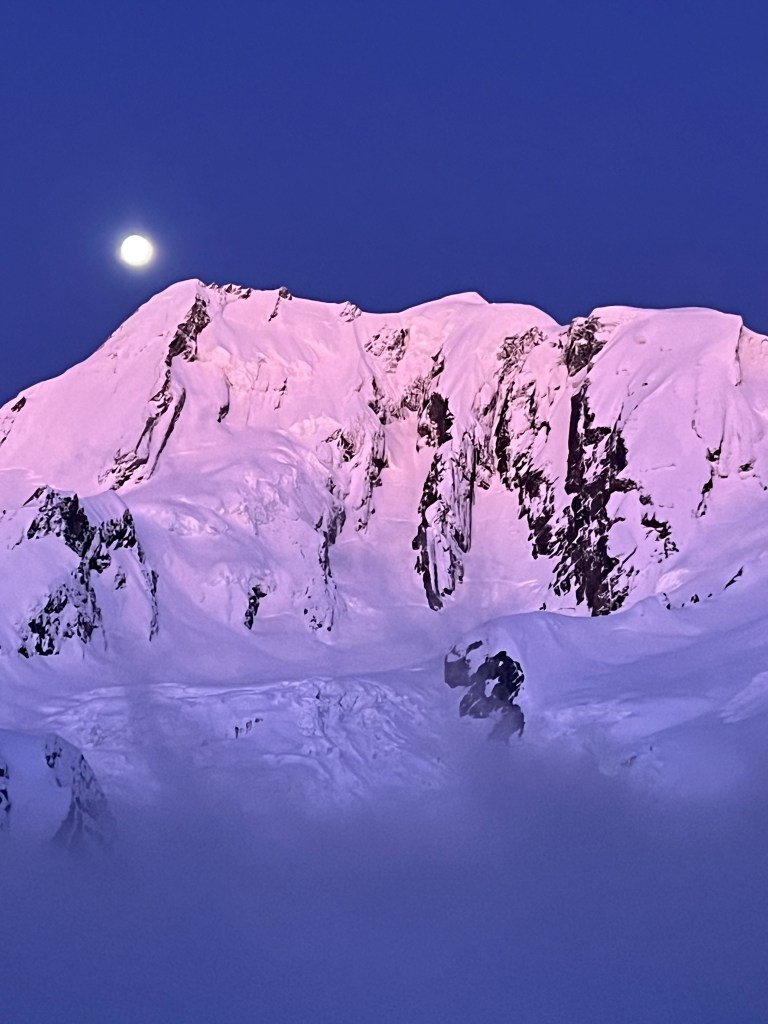
Glancing over my shoulder, Elie was bathed in afterglow like a crimson tide of dragon’s blood. We paused in awe, very happy for the mental distraction from our latest battle. Mother Nature continued to put on a show as the full moon rose behind Elie, illuminating the landscape and removing the difficult task of navigating home from our weary minds. The Milky Way appeared particularly vibrant directly overhead in the Southern Ocean skies free from light pollution that we are familiar with in the Northern Hemisphere. For the first time, I saw Starlink, emitting pulses of green light as it orbited planet Earth. We ground on reaching the hut at midnight to join the other occupants already snuffled in the safe warmth of their sleeping bags.

 Ross Hewitt Guiding