New Zealand – a film about skiing on Aoraki

In the words of Sam Smoothy ‘sometimes New Zealand can be a cold hearted mistress.’ She was certainly giving us the ultimate in cold shoulder treatment as day after day the South Island got battered by storm force winds as much as 75 mm of precip. The Wyn Irwin hut near Mount Cook village provided us with friendly and cosy refuge. Amongst the temporary residents were the guardian Cam Mulvey, Laura from the DOC Kia Preservation Project, Aussie Tim who was on the Plateau hut build team, Eifel from Singapore and Beau Fredlund from Yellowstone and endless banter passed the time and kept spirits high. It was a chance to adjust to the 12 hour time change, clear the mind and focus on what lay ahead, and do some trail running surrounded by the lakes and glaciers of the rugged Hooker valley.
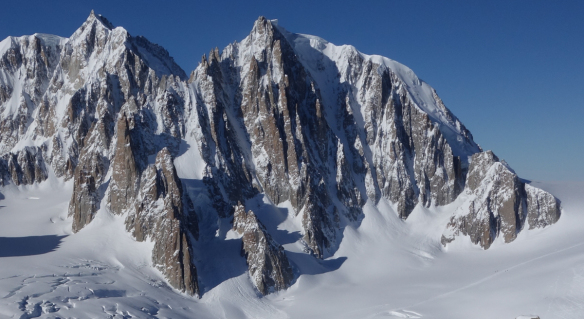
Back in June Smoothy and myself had started talking about collaborating on some ski projects in the Southern Alps but a dry August had me holding back from buying a airline ticket. Finally in September the snow came and when I saw some activity in the mountains I pressed the button on a ticket. After beating around the bush for a while swapping messages we got to the point and started discussing a new line on the 1400 m Caroline Face. This had seen its first descent in 2017 by Grant, Mosetti and Briggs, a trip I had to pull out of at the last moment due to herniating the lowest disc in my spine onto the sciatic nerve root. A big glaciated face like this changes from season to season and when the door on one line closes others may open. To put it in context the West Face of Mont Blanc is similar in size and holds 4 independent ski routes which are rarely all in condition simultaneously. Since skiing 1000 m + faces is in powder is my thing, I still had an interest in the Caroline Face and the opportunities it holds for skiers. That said it pays to be careful who you speak to outside of the steep skiing fraternity as it makes the uninitiated uncomfortable as their pulse quickens, the blood drains from their face and they stare at your through glazed over eyes as if you are crazy. Its just a question of what you are used to and my last runs in my backyard where Couturier, Mallory and the ultra tech steep and exposed Aiguille du Plan North Face. In Chamonix anything is possible but in NZ you need one day when you won’t be ripped off the mountain by then wind catching the skis on your pack. Doesn’t sound like too much to ask right?
I was all set to fly solo, relishing the chance to do my own thing after a busy guiding summer. So it was a surprise bonus when Dave Searle asked what I was up to and bought a ticket too.
The breaks in the weather were small this spring, mainly too short to make a valley approach and ski the next day and It seemed unlikely there would be sufficiently weather window to make it worthwhile for local Smoothy to hook up. So when we saw a tiny couple hour window we jumped at the opportunity to fly into Plateau hut joined by Yellowstone resident and ski guide Beau Fredlund to get amongst the skiing. We landed there in -20C and bottomless powder that was going to make getting up anything a challenge. Here’s what we got up to.

Film – Skiing lines on Aoraki, Mt Cook, NZ

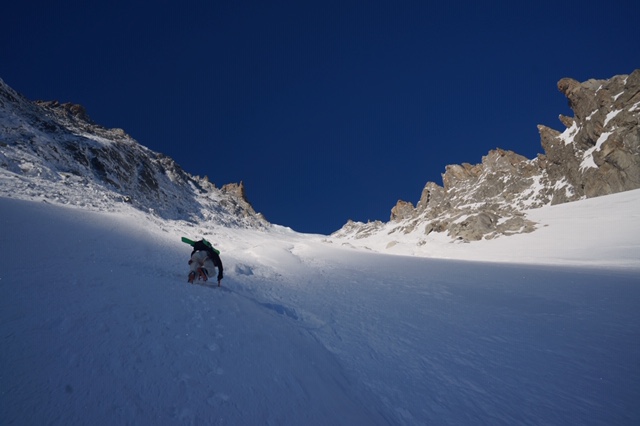
A short film of Ross Hewitt and Dave Searle skiing lines on Aoraki Mount Cook 2019 including a new line on the Caroline Face, a descent of the East Face in deep powder and the second descent of the Bowie Couloir after Andreas Fransson and Magnus Kastengren’s descent in 2012.

In the words of Sam Smoothy ‘sometimes New Zealand can be a cold hearted mistress.’ She was certainly giving us the ultimate in cold shoulder treatment as day after day the South Island got battered by storm force winds as much as 75 mm of precip. The Wyn Irwin hut near Mount Cook village provided us with friendly and cosy refuge. Amongst the temporary residents were the guardian Cam Mulvey, Laura from the DOC Kia Preservation Project, Aussie Tim who was on the Plateau hut build team, Eifel from Singapore and Beau Fredlund from Yellowstone and endless banter passed the time and kept spirits high. It was a chance to adjust to the 12 hour time change, clear the mind and focus on what lay ahead, and do some trail running surrounded by the lakes and glaciers of the rugged Hooker valley.

Back in June Smoothy and myself had started talking about collaborating on some ski projects in the Southern Alps but a dry August had me holding back from buying a airline ticket. Finally in September the snow came and when I saw some activity in the mountains I pressed the button on a ticket. After beating around the bush for a while swapping messages we got to the point and started discussing a new line on the 1400 m Caroline Face. This had seen its first descent in 2017 by Grant, Mosetti and Briggs, a trip I had to pull out of at the last moment due to herniating the lowest disc in my spine onto the sciatic nerve root. A big glaciated face like this changes from season to season and when the door on one line closes others may open. To put it in context the West Face of Mont Blanc is similar in size and holds 4 independent ski routes which are rarely all in condition simultaneously. Since skiing 1000 m + faces is in powder is my thing, I still had an interest in the Caroline Face and the opportunities it holds for skiers. That said it pays to be careful who you speak to outside of the steep skiing fraternity as it makes the uninitiated uncomfortable as their pulse quickens, the blood drains from their face and they stare at your through glazed over eyes as if you are crazy. Its just a question of what you are used to and my last runs in my backyard where Couturier, Mallory and the ultra tech steep and exposed Aiguille du Plan North Face. In Chamonix anything is possible but in NZ you need one day when you won’t be ripped off the mountain by then wind catching the skis on your pack. Doesn’t sound like too much to ask right?

I was all set to fly solo, relishing the chance to do my own thing after a busy guiding summer. So it was a surprise bonus when Dave Searle asked what I was up to and bought a ticket too.

The breaks in the weather were small this spring, mainly too short to make a valley approach and ski the next day and It seemed unlikely there would be sufficiently weather window to make it worthwhile for local Smoothy to hook up. So when we saw a tiny couple hour window we jumped at the opportunity to fly into Plateau hut and get amongst the skiing. We landed there in -20C and bottomless powder that was going to make getting up anything a challenge. Here’s what we got up to.

October Ski Mont Blanc du Tacul

October 3rd and we just had a big storm with 40 cm up the  Midi.

It was a lush sunny day with good friends skiing off the Aiguille du Midi and Tacul.

Always an adventure putting your skis 🎿 on in the ice cave and sliding out through the portal in the magical world of sunny 😎 alpine mountains. One minute you are all cost asked in bed 🛌, and less than an hour later boom 💥

Good to see fellow Chamlads @joelevans @digitalsteak @olly_alkema


Petzl Irvis Hybrid Crampon Review

d48d2332-3a0d-4e77-81da-64268c4c30ff

Running out the rope between spike belays guiding Breche Tacul. Photo Sam Burrell

Petzl’s dedicated ski mountaineering crampons series have been around a couple of years now which is more than long enough to test new technology and its durability. Petzl took a new approach connecting the steel front and aluminium rear sections of the crampon with dyneema rope or Cord-Tec in Petzl speak. This not only reduces weight but its main advantage lies in the ability to fold the crampons in half and reduce the overall pack size. Getting everything to pack down smaller is the holy grail and means my 27-32 litre pack works for everything from technical Chamonix day hits to 6 days hut to jut touring through the Alps. A compact pack brings its centre of gravity close to my back. The closer its centre of gravity is to my own reduces the lever on my core muscles and helps me ski faster, longer, better.

T02A-LLU-IRVIS-HYBRID-focus-2_LowRes

Compact Pack Size. Photo Petzl

The combinqtion of steel toe piece and lightweight heal piece is perfect for ski mountaineering where you might be climbing up a alpine face and encounter some hard black ice or need to negotiate some sections of rock scrambling. The spec weight is 570 g with the anti-snow plates fitted. They come with both a wire and universal front bail so fit boots in the B2 & B3 categories.

DSC00726

Col de la Verte. Photo Koen Bakers

Out of the box I set my crampons up on my boots and went out ski touring in Arolla. We ended up climbing along a prolonged rocky ridge and after a while I noticed the toe piece had a tendency to yaw or skew to the side – something a traditional crampon can’t do due to the torsional rigidity of the bar. I then realised the dyneema had ‘bedded in’ to its working length and I just needed to adjust the tension up. You can do this at home with the crampons fresh out the box, putting them on and off the boot and tensioning using the dyneema hooks at first then micro adjusting by moving the heal bail a notch further forward.

IMG_0481

Ross Hewitt Climbing Col de la Verte. Photo Drew Tabke

IMG_0506

Ross Hewitt Skiing Col de la Verte. Photo Drew Tabke

So I’ve used these on everything from climbing the 700 m 50/55 degree Col de la Verte ice face, guiding Dent Blanche and the Matterhorn or climbing fast and light alpine routes like the Peigne, Pelerins, Deux Angle, Plan, Midi traverse. They are utterly brilliant and the dyneema stands up to all the abuse you can throw at it, being extremely abrasion resistant. After 2 years with around 400 days on the mountain, the aluminium heal has worn more than the dyneema so there are no worries about how robust these crampons are. I was particularly impressed with the quality of the steel and only recently sharpened them for the first time in preparation for skiing the North face of the Aiguille du Plan. In winter I used them on ski boots with the wire and in summer on the new fast and light Scarpa Ribelles with the universal bail. They are light enough so I only take the full aluminium Leopard crampons if I know I’m only going to travel over snow.

IMG_1074

Traversing Peigne, Pelerins, Deux Angles, Plan, Midi. Photo Andrew Wexler

Unlike most crampons which are asymmetric, these crampons are identical except for the position on the buckle which would conventionally be on the outside of your foot. However, for steep skiing I put this on the inside as the body doesn’t not bend that well to do up crampon straps on the outside while hanging onto steep faces!

IMG_2864

Ross Hewitt Guiding Dent Blanche. Photo Tim Neill

20517451_10155763836608984_752614314_o

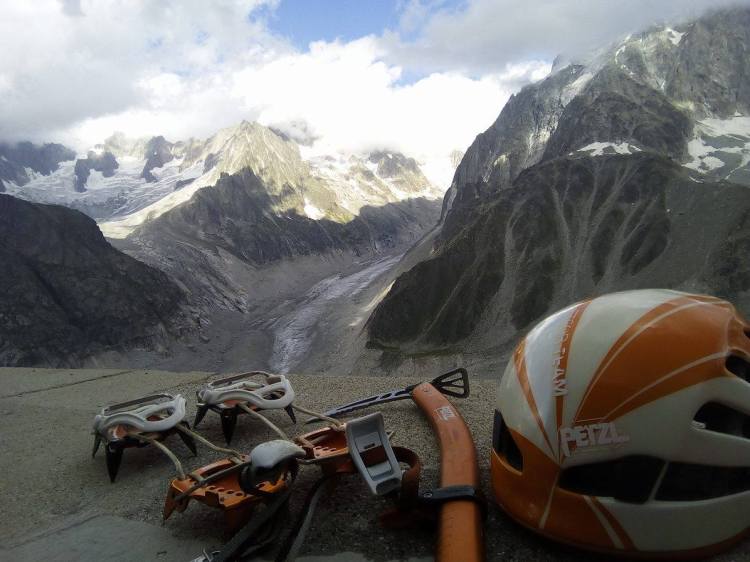
Gear for glacier approaches to rock routes at Envers des Aiguilles