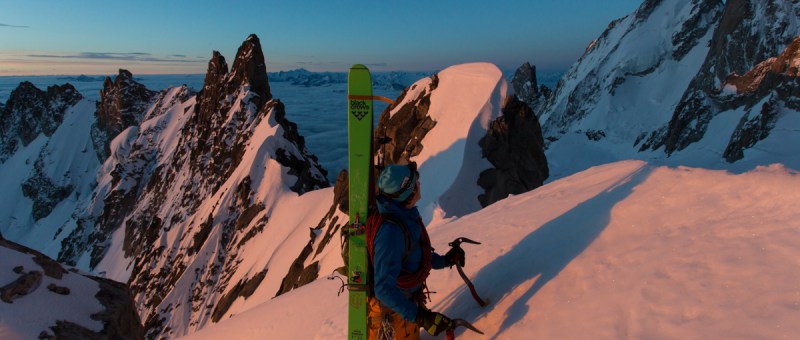
The Brenva Spur

Brenva Spur Enrico Karletto Mosetti

The Brenva Spur

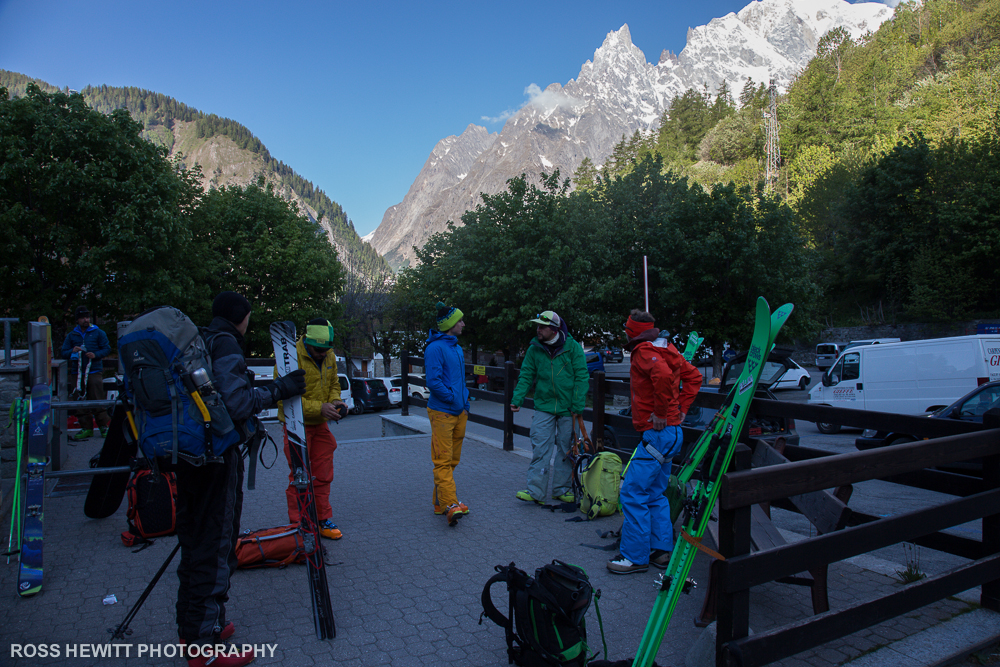
We arrived at the Cosmiques hut with the plan to climb Tacul and Maudit and ski the Brenva Spur on-sight, but news there had been 40cm of snow dampen our enthusiasm. Tour Ronde and the Brenva Face had been in the rain shadow, while the Chamonix side had received a pristine bounty. As the afternoon cloud lifted we studied the voie normale and considered our options. There was good chance of being forced back in the dark by avalanche risk if we opted for Tacul and Maudit, so we went the long way round, over Col de la Fourche.

We woke just after three in the morning, forced down as much food and water as possible, and headed out into the night to ski the Vallée Blanche. The night was black as ink and the usual summit reference points were cloaked in darkness. Even my powerful head-torch’s beam seemed to be absorbed by the night. Navigation became difficult. Suddenly, something unfamiliar began to form in the darkness – a strange shadow against what little light there was. We broke left to ski parallel to a chaos of huge ice blocks as much as four metres high. The seracs under Col du Diable had fallen. We continued to ski down the Vallée Blanche, beside the avalanche, all the while adding yet more distance to our day. Eventually, after a considerable detour, we were able to ski round the toe of the debris and start back towards Cirque Maudit. Our friends had passed this way the previous afternoon while traversing from Torino to Cosmiques, so we knew this biblical serac fall must have happened in the last few hours. It was an ominous portent for the Trilogy.

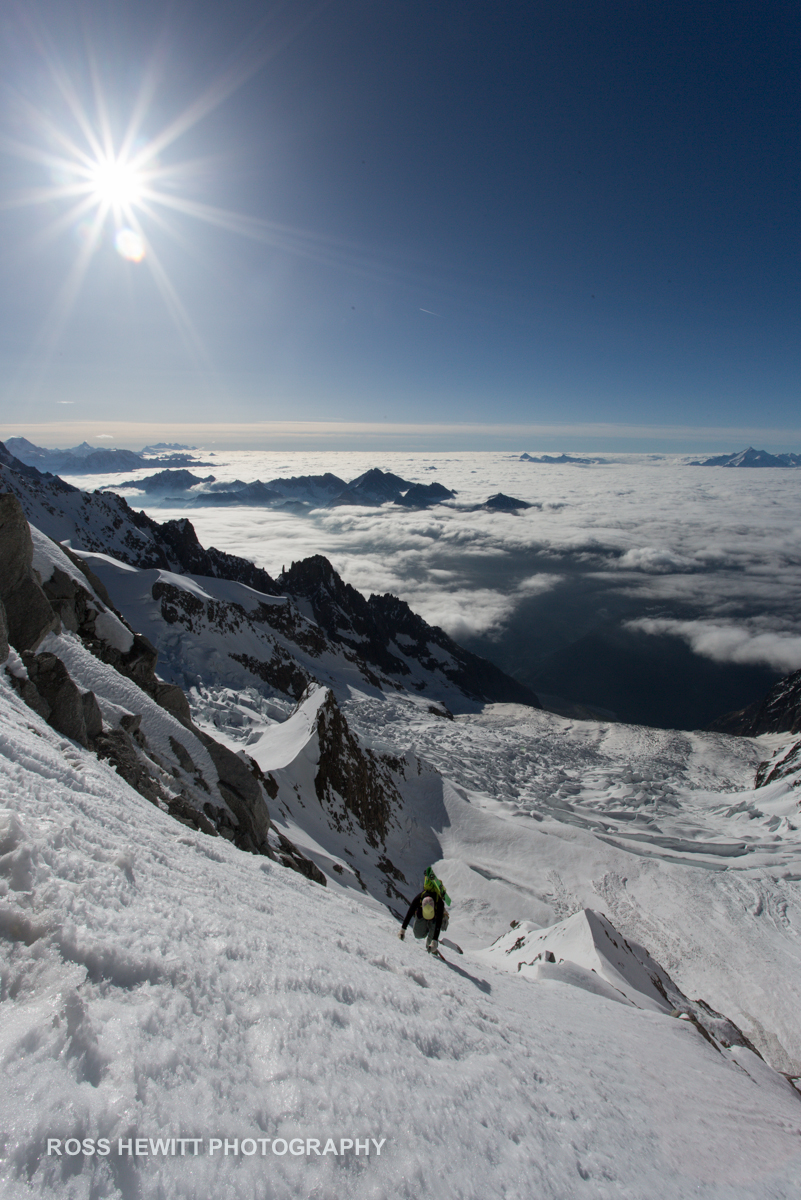
Brenva Spur Tom Grant Ross Hewitt

Brenva Spur Tom Grant Ross Hewitt

At Col de la Fourche we met with dawn as the sun peered over the eastern skyline. That moment of first light is a revelation for the mountaineer whose senses have been deprived in the dark. Fear, anxiety and doubt evaporate as all becomes clear, calm is restored and the low point in the soul disappears. In front of us the Brenva face revealed its magical hidden secrets.
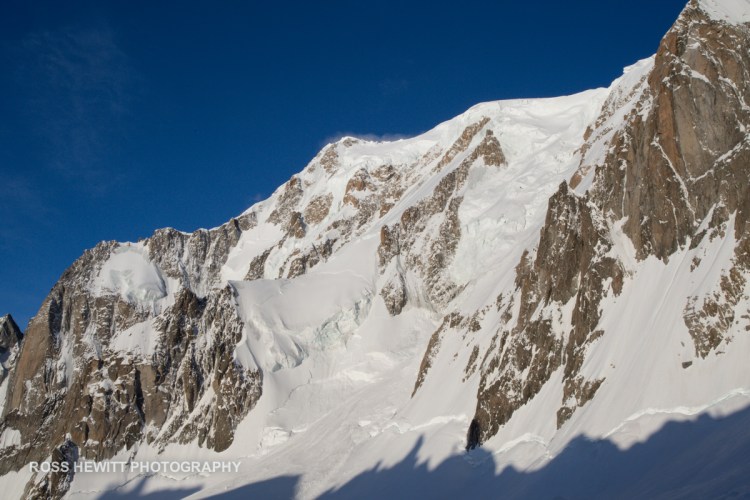
Brenva Spur Ross Hewitt

Crossing Col Moore at just before seven that morning, we stashed excess kit in the snow to reduce pack weight before starting up the route. We left behind our skins, ski crampons, ropes, shovels, probes, and extra food and water for the return leg. We would travel through survivable avalanche territory on the way back, but on the route itself only a transceiver was needed for body retrieval by the rescue services. Having estimated the snow would be soft enough to ski by half-past-eight, that gave us a leisurely hour-and-a-half to bootpack 700m. 
Brenva Spur Ross Hewitt Tom Grant Brenva Spur Enrico Karletto Mosetti Ross Hewitt

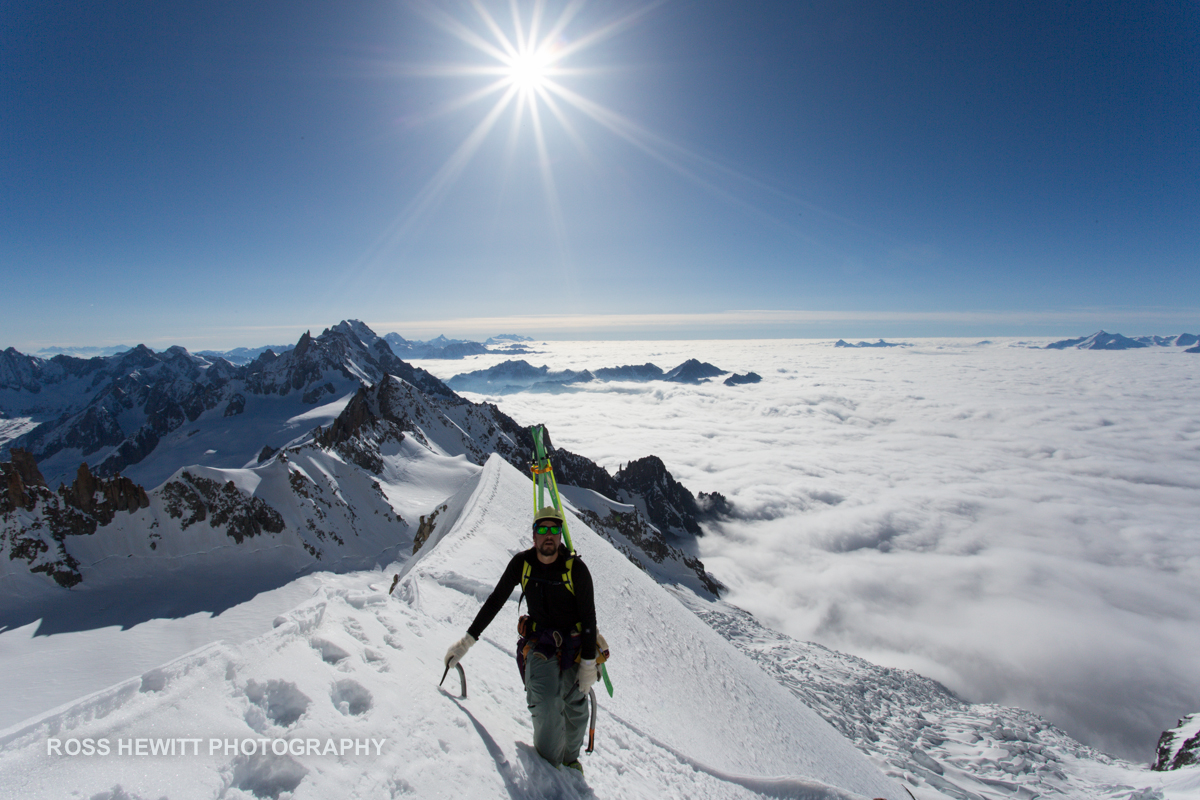
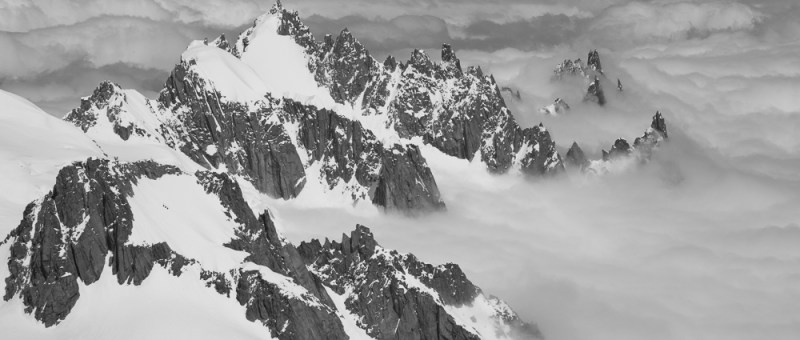
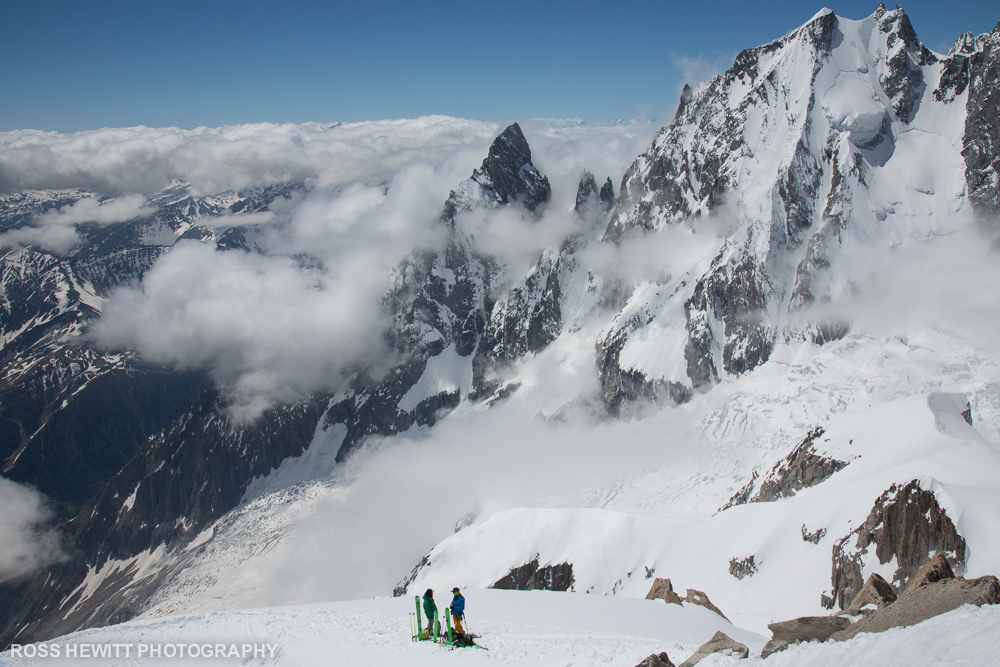
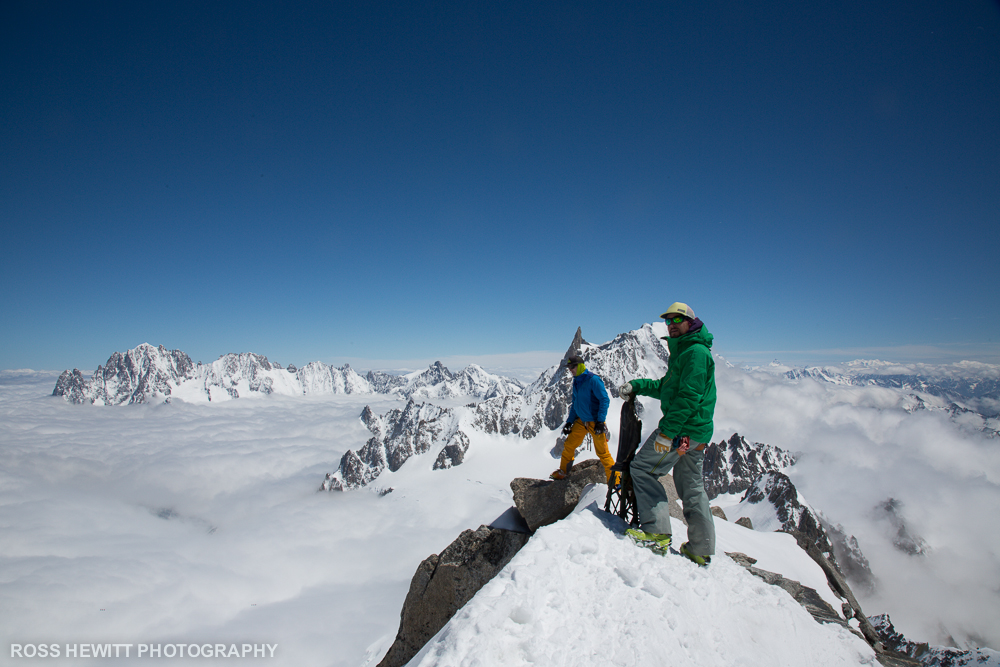
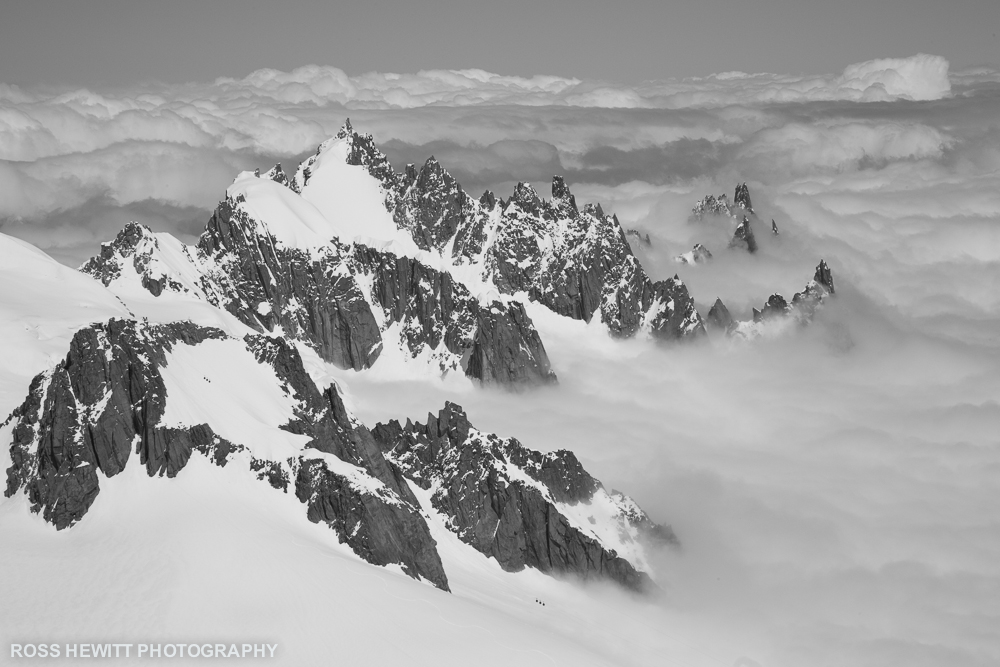
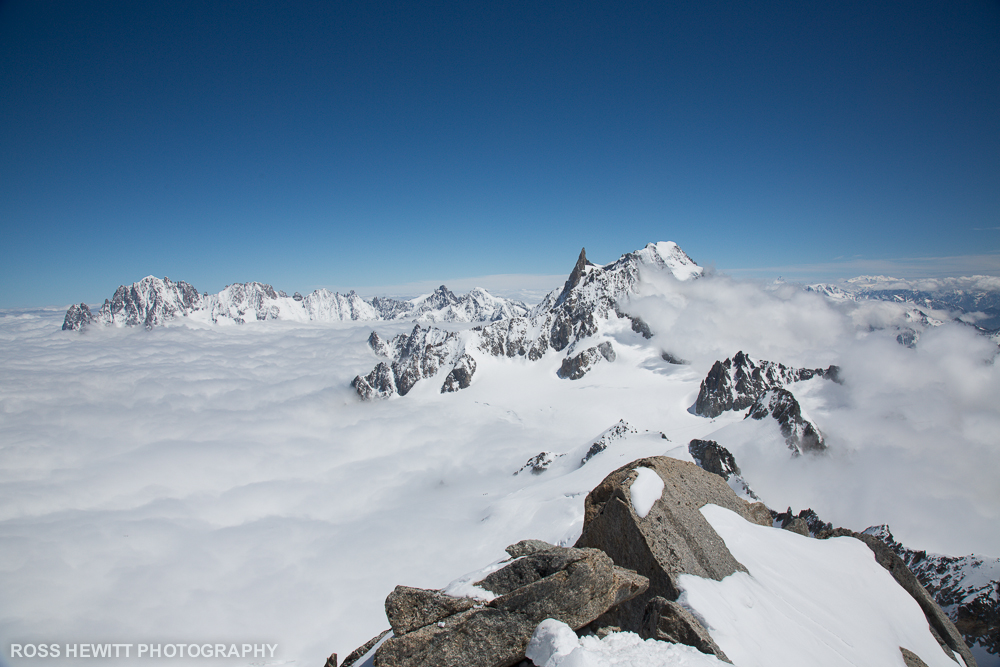
The air was still and a blanket of cloud was drawn over the landscape below keeping Italy snug. Most people would still be curled up in bed enjoying a lazy Sunday morning. Snow and ice crystals glimmered, and the temperature was pleasant enough to climb the iconic curling arête of the Brenva Spur in thin mid-layers. We quickly covered the final few hundred metres to the pyramid rock tower, gatekeeper to the serac exit onto Col de Brenva.Brenva Spur Enrico Karletto Mosetti Ross Hewitt 1Brenva Spur Enrico Karletto Mosetti Ross Hewitt 2

Brenva Spur Sidetracked lores-10Brenva Spur Enrico Karletto Mosetti Ross Hewitt Tom Grant

Brenva Spur Enrico Karletto Mosetti Ross Hewitt 3After stamping ledges in the snow, we swapped crampons for skis and took in the magnificent surroundings. The endless east face of Mont Blanc lay to our right, a crazy mix of couloirs, buttresses and tumbling seracs that held historic alpine climbs such as Route Major. Sun-warmed powder waited for us on the upper section but, as I gazed on it, I wondered how it would ski. Brenva Spur Enrico Karletto Mosetti Ross Hewitt 4

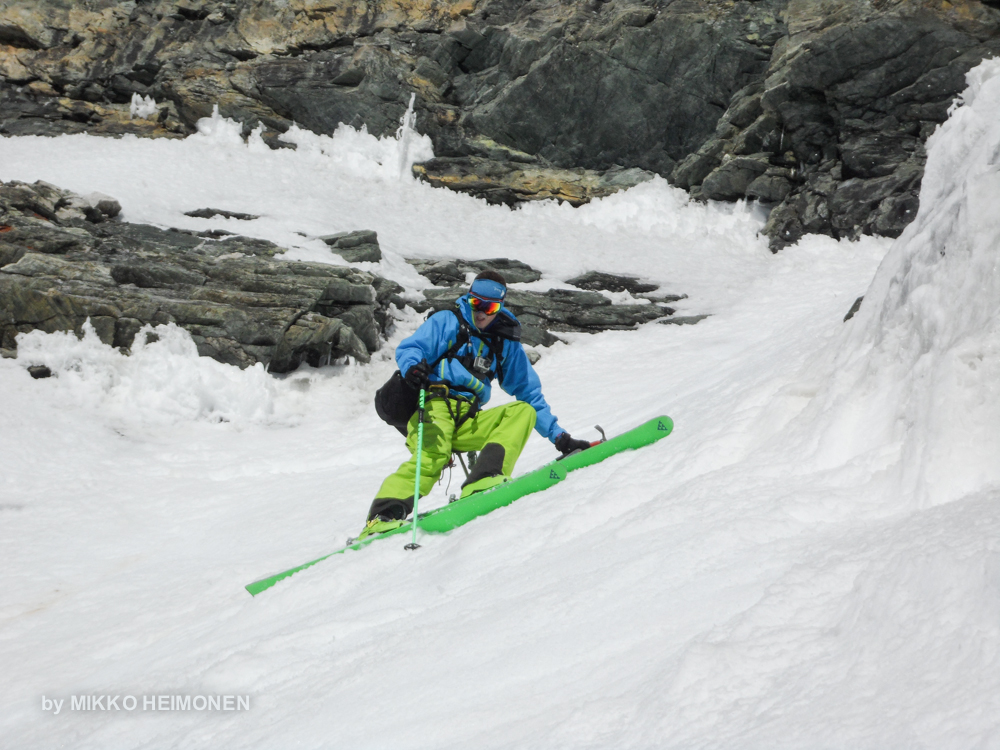
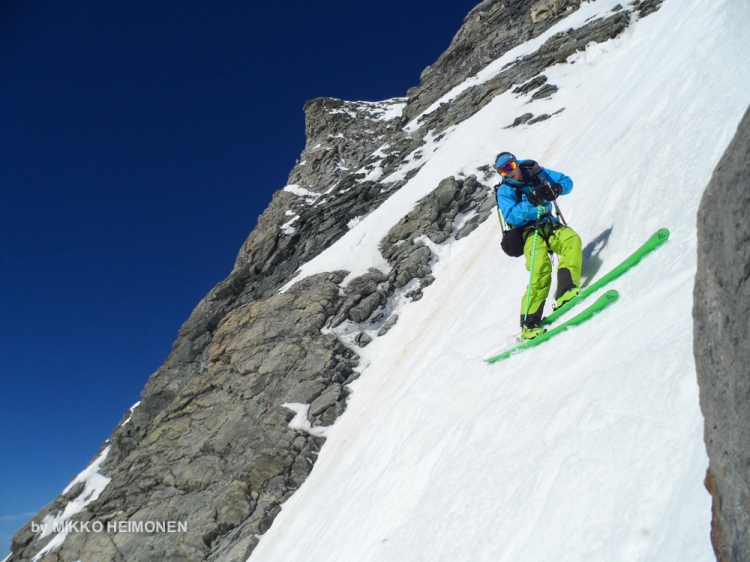
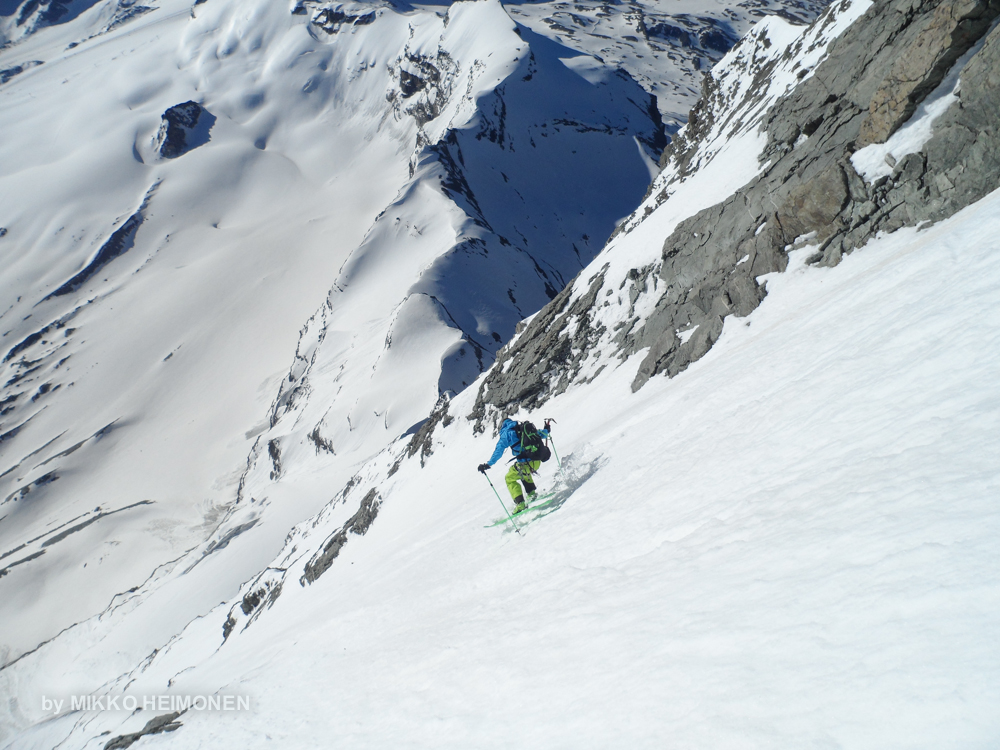
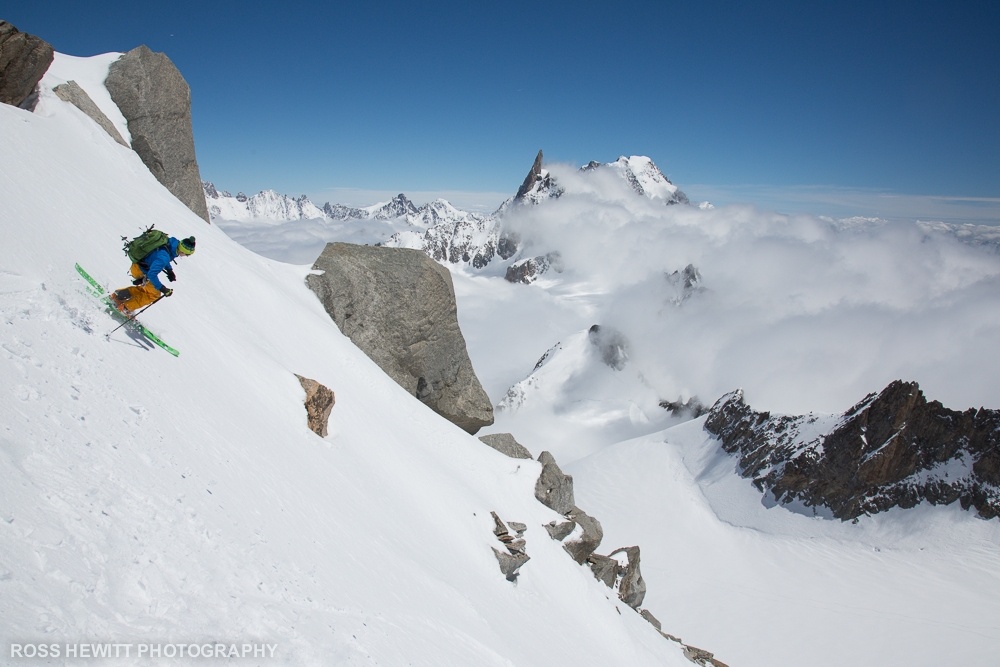
We skied some cautious turns initially, allowing our sluff to run in front until we had passed a section of shallow snow over the ice. Then the angle eased, allowing us to open it up more and a dozen turns of almost sensual skiing took us to the narrow arête. We dropped onto wide open slopes holding perfect spring snow sucking in a couple of hundred metres in five or six swooping turns. Smiles all round.

Screen Shot 2015-05-25 at 11.21.54Enrico Karletto Mosetti Ross Hewitt 5

Brenva Spur Enrico Karletto Mosetti Ross Hewitt Tom Grant 2


Now, however, we had to cross back over the Brenva glacier and Col de La Fourche before the final 600m skin back up the Vallée Blanche to the Midi. We were all hit by a sudden slump in energy as we skinned back towards the Fourche, the adrenaline of the descent fading, replaced now by heavy fatigue. The fun was over and it was time to push hard for the last three hours and escape the searing alpine sun.

Expedition Photography and Food

I was recently asked a few questions by one of the adventure magazines on how I prepare and take care of camera equipment, food and communications on long expeditions. For all of you heading to remote areas of the planet here is some of the lessons I learnt the hard way.

As a photographer, how do you prepare your material for an expedition, do you take several cameras (compact or reflex) tons of extra batteries, some solar panels… Do you have a few tips ?

Its depends on how remote the trip will be. For instance in South America we were never more than a couple of days from civilisation so it would be easy to pick up another camera if it failed. In a remote location like Baffin you bring absolutely everything you need with you onto the island with the exception of white gas. Redundancy was key and that meant I took 2 of everything electronic with a laptop to back up images. We even had spare bindings and a spare ski predrilled with quiver killers for everyone’s boot size. For Baffin I took and 5D SLR with multiple lenses and a sony RX100 compact (1” sensor). For each camera I had 3 batteries to cope with the extreme cold and all the kit was stored in a pelican case. The case was essential as the vibration and shock during the ride in on the wooden komtatik sled and when we where moving camp by kite skiing and hauling the gear on sleds would have destroyed 10K of photography kit quickly. I was definitely rewarded for the effort and you can check out the results here: http://rosshewitt.net/2015/02/10/baffin-island/

I’d also heard stories of lenses getting damaged due to the change in temperature and humidity when taken inside the tent so I kept my cameras in the cold, in their pelican box at all times when they were not in use. I also took the batteries out when not in use and kept them in a zip lok bag in my chest pocket several layers away from the cold. 

To charge all the electronics we took 2 Goal Zero systems, 1 Yeti 400 and 1 Sherpa 100 combined with 2 x 20 W solar panels. At 71 degrees North in April with both panels daisy chained we harvested a meagre 4-12 Watts from the sun. i.e. the panels were pulling 10-25% of their rating. Get foldable panels or roll up panels if you are travelling so they don’t get broken.  If I was travelling large distances again in a remote area then I’d take a Sherpa 100 and Sherpa 50 system as the Yeti 400 felt like a brick at 15kg. You have to calculate how many Watts you will need – a hard drive laptop uses nearly twice as many Watts as a solid state drive laptop. 

Top tips: redundancy is the key, plan for everything breaking or getting lost and take several memory cards. Back everything up. Make sure you don’t just have one essential cable or tripod mounting plate! Avoid moving your expensive kit from cold to warmer, humid environments and vice versa and remove ice crystals from the lens by thawing them with alcohol – simple rubbing them off will scratch your glass!

Baffin Berghaus Black Crows Ski Mounatineering Expedition-33

The Goal Zero Solar Panels and the Pelican Case for the Camera Kit (left)

For the food, how do you plan for food supply ? Do you think in terms of calories per day, do you try to have a good varieties of choice, only freeze-dried….

For the big expeds I plan food on calorie consumption per day. Baffin was based on 6000 kcal/day intake with the main meals being freeze dried food supplemented with snacks. A lot of calories were spent combating cold – we had 1200 fill -88C sleeping bags and Exped down mats and I was still wearing 6 or 7 layers at night. We had to take freeze dried food to Baffin because our 7 base camps were over 240 km apart and we each started out with 110 kgs to haul. For trips where we are not travelling then I try and get a high level of normal food but it depends on how harsh the environment is – cooking in -35C is a chore rather than a pleasure! For snacks I go for largest variety of nuts, chocolate, biscuits, sweets and dried fruit. Its also nice to take some powdered deserts that can be made with water. After 35 days, covering 240 km and climbing 20200 m vertical I had lost 15% of my body weight which was primarily muscle. That said it would be hard to eat much more but when you are on the trip of a lifetime surrounded by stunning lines , 24 hour daylight and good weather its hard to sit still.

Variety is key and its better to have too much than too little. 

Top exped food tips: 

  • Beef jerky was by far our most favourite snack and our bodies just craved protein. 
  • I need at least a triple expresso to get going in the morning and being a coffee snob freeze dried stuff just won’t do. Aeropress make a simple, robust 25 dollar coffee maker that is the business and forces the hot water through the grains under pressure. Its also super easy to keep clean even when its so cold that your piss freezes before it hits the ground. Forget Jetboil presses and check out the Aeropress, take it everywhere now. http://www.aeropress.com/ 
  • Take a thermos flask for hot drinks
  • Take water bladders and keep them insulated in a sleeping bag.
  • The down Exped mats will insulate you well from the cold ground and lower calorie consumption. Combine with inch thick foam mats just incase you get a puncture thats not repairable.
  • Eat every moment you have time and at night make sure you eat some fat as you will sleep warmer. We put a spoon of butter in hot water before bed!
  • Take a variety of drinks, teas, coffee, powdered energy drinks powdered milk etc

For communication, do you care about it ? Do you try to have a satellite phone or a radio ?

The level of comms is dependant on location and mobile phone coverage. Out side mobile coverage you have to determine if a cheap 2 way VHF radio will enable you to communicate with rescue services or if a satphone is the only method of comms. Satphones can be rented at reasonable rates, for trips longer than 30 days it will be worth buying one. Iridium satphones are more expensive but are mandatory for the North Northern Hemisphere whereas cheaper Thuraya satphones will work in Europe and Asia. We also have a satellite texting device made by InReach which is a cost effective way of texting your sponsors from the farthest corners of the Earth with Twitter updates. Always have the emergency / help numbers stored as you never know when they will be needed.

Final tip: if you are going to be remote for a long time then plan every detail, as they say: ’the Devil is in the detail.’

The Unsung Heroes

So you are all used to me posting photos from the rad places our skiing adventures take us and thats cool, but what you are seeing is the result of a team of unsung heroes who go that extra mile to make sure I’ve got the best chance of succeeding on my latest project. And I’m not talking about major sponsors, they get tagged in all the media posts and regram, retweet through their own channels. I’m talking about the guys on the ground in my home town who help me out day in, day out, and who I have a massive debt of gratitude. They are the unsung heroes:

Colleen at Chamonix Sports Massage helps loosen up all the fascia and tendons  as they start to bind up from day in, day out use in the mountains combined with the evils of sitting a desk for hours with poor posture and insufficient stretching. Chamonix Sports MassageI’m not so indestructible these days and the occasional tomahawk or face plant seems to knock out ribs, collar bones and vertebrae. How the hell I ever coped with the big stacks on downhill bikes is a wonder but these days Carlton the osteopath at La Clinque du Sport does a brilliant job of putting everything back in its place.     clinic du sportJules and Damien at the Bootroom ensure I have race fit boots pushed round all my bones spurs to fit like a glove and never tire of me coming on to get replacement buckles and power straps that have been ripped off. Damien Jules Concept Pro Shop Chamonix provides the best professional service for ski tuning and binding mounting. Craig and Davide will give you a friendly pro service and on Tuesday evenings give you a beer while you wait for your skis.concept pro Graham and Colin at Footworks are the guys I go to for general kit tweaks, workshop mods and replacement stuff that I broke or lost. Without them I’d be stuffed. sport alpin

The Alpine Trilogy Project – Skiing’s Triple Crown

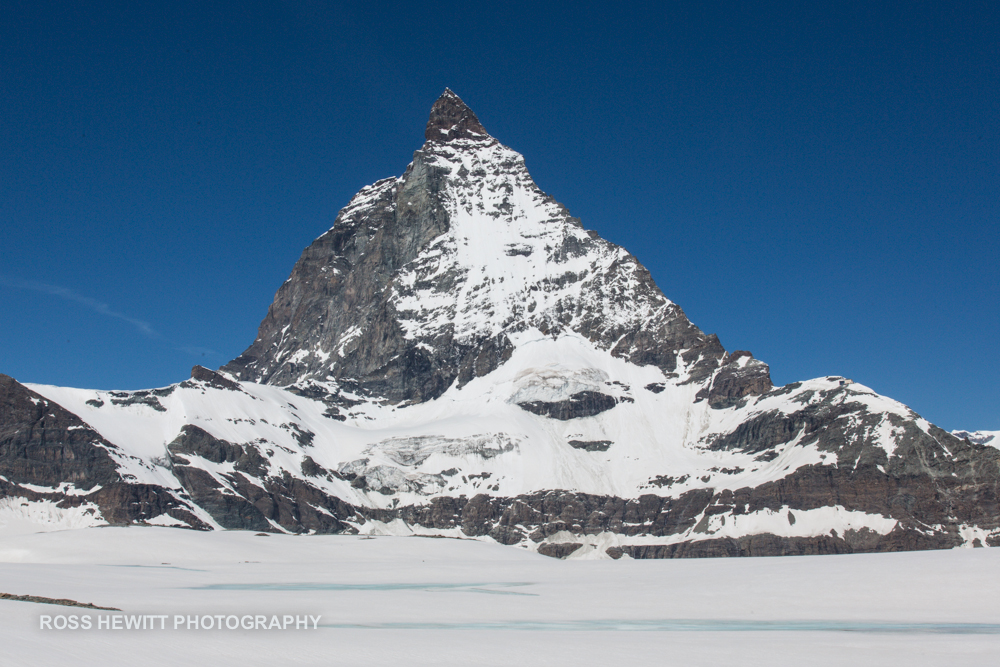
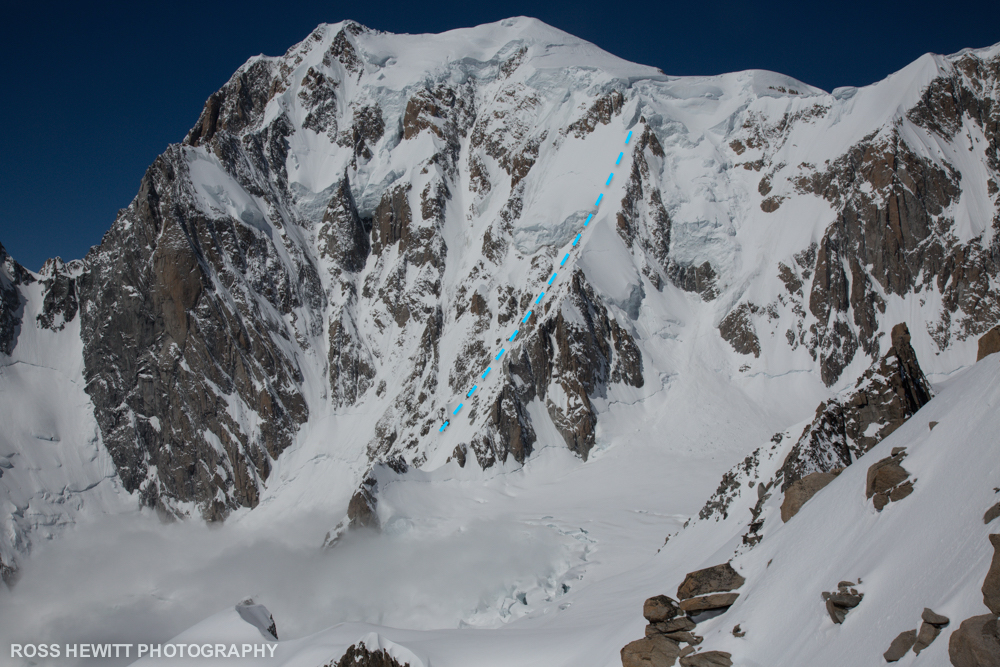
Its been a busy few weeks here which kicked off after a heavy dump of snow plastered all the faces.  A project had been forming in my mind over the last year which involved skiing and shooting 3 of the biggest, baddest and hardest lines in the Alps. The Matterhorn is perhaps the most well known and iconic mountain in the World. Any time you ask a child to sketch a mountain they draw you the outline of the Matterhorn.  Its East Face is an incredible slab of rock, steep enough to defy logic that snow will stick, and its rarely in condition. The West Face of Mont Blanc was a must, Himalayan in scale, the upper pitch alone is 1200 m of 50º starting at 4810 m, combined with another 1000 m of 45º couloir skiing below. This one had been alluding me since 2009 and in years when you have already been skiing for 7 or 8 months, its tough to hold out through June for it. The obvious choice for final route would have been the Eiger West Face but I’d already done it in 2011 and my interest lies in exploring new places. Having not skied in the Brenva Cirque, the Brenva Spur was the obvious choice. A route steeped in history and coveted by Alpinists in a remote and wild setting. After a mild season with low valley snowfall levels, we would be entering and leaving the Brenva by Col de la Fourche and the Aiguille du Midi rather than being able to ski out to the Mont Blanc Tunnel.

All that remained was getting the right partners with the head, experience, strength and fitness to take on these big days. When we embarked on the project I guessed there was 50% chance of completing it in 5 years. The Brenva fell to us first in a 12 hour day and a few days after we nailed the West Face in a 14 hour day – the last 3 hours without water. Reassessing our chances I now put them at 60% chance of completing the project this season but the long term forecast was showing that temperatures would rocket.  A couple of days later we were off to Zermatt for what would be our only shot at it. And we did it!

Skiing the Trilogy or Triple Crown in a period of ten days days was a full on experience, mentally and physically. The shortest day was the last one at 10 hours, all 3 days were at 4000 m or more, and all were a race against the clock before conditions became dangerous in the heat of the day. A bit like doing 3 iron man races in 10 days? Maybe, but who cares, this was a personal quest to ski and shoot in wild places with my friends.

Finding skiers who have enough energy left for some big pushes at this time of the year can be tough but a big thanks to the ever psyched and super strong guys who joined me at various stages along the way to make this project a massive success: Mikko Heimonen, Jesper Petterson, Tom Grant, Enrico Kareletto Mosetti, Guilhem Martin Saint Leon.Below are a few shots from the trips with the good stuff and full blog post still to come.

Sunset Midi Chamonix Cosmiques Ross Hewitt-1

Sundown from the  Cosmiques Refuge, en route to the West Face with lots of trail breaking to do over Tacul and Maudit.Matterhorn Moon Light Ross Hewitt-1

The Matterhorn East Face under full moon as Mikko Heimonen sets off from camp.Matterhorn Cervin East Face Ski Topo Routes Ross Hewitt-1

The East Face plastered the day we skied it.Mont Blanc West Face Ross Hewitt topo

The West Face of Mont Blanc with our lineBrenva Spur Topo Ross Hewitt-1

The Brenva SpurMatterhorn Cervin East Face Ski  Ross Hewitt-1Heading in the Matterhorn, with low cloud we couldn’t see the line in the upper couloirsSunrise Aiguille du Midi Chamonix France Ross Hewitt-1

The Midi or Mothership at Dawn, the best ski lift in the WorldScreen Shot 2015-05-25 at 11.21.54

POV Shot from the Brenva Spur, Italy under a sea of cloudsMatterhorn Cervin East Face Ski  Ross Hewitt-1-2

55º uppers on the Matterhorn above and below


Matterhorn Cervin East Face Ski  Ross Hewitt-2

Screen Shot 2015-06-07 at 16.48.00Some POV on the Matterhorn in a steep section looking towards Zermatt.Matterhorn Cervin East Face Ski  Ross Hewitt-1-3 In the upper central couloir of the Matterhorn
DSC05539

Me on the Saudan’s West Face line – photo Guilhem Martin Saint Leonbrenva


Enrico Karletto Mosetti and Tom Grant on a lush morning on the Brenva Spur